

Why Does “Handmade” Still Matter?
In an era of algorithmic recommendations and next-day shipping, the word “handmade” can feel like a marketing tactic. It gets stamped on products that were assembled by one person and manufactured by a hundred others. The meaning has been diluted.
But for some objects, handmade is not a label — it is the process itself. A handcrafted gift that requires human judgment at every stage, from design to finishing, is fundamentally different from something that rolls off a production line. The difference is not sentimental. It is structural.
At Urban Frames, every city relief is handmade in Romania. Not assembled. Not finished. Made — from the first data file to the last coat of finish.
The Workshop in Bucharest
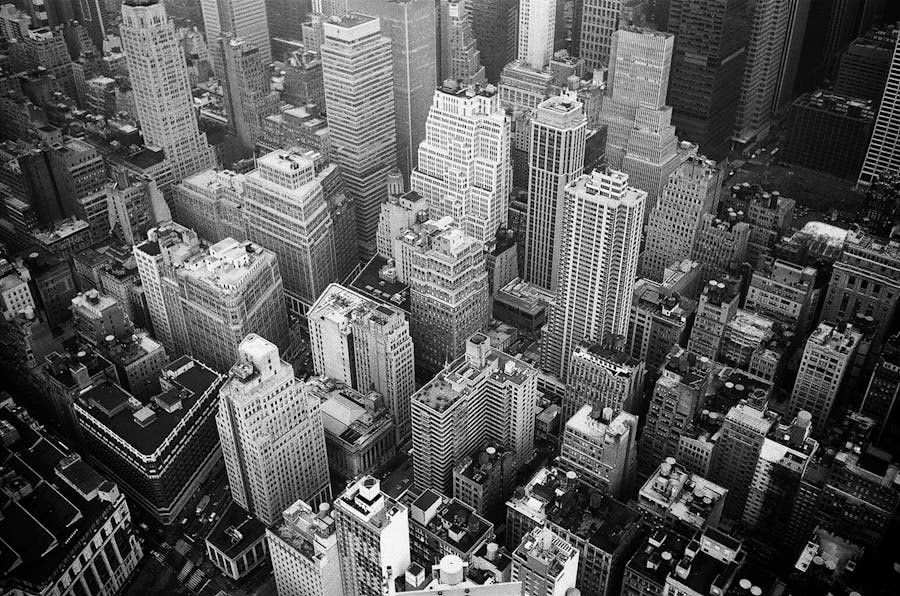
Our workshop sits in Bucharest, Romania’s capital and largest city. Bucharest is not the first place most people associate with artisan craft, but it should be. Romania has deep traditions in woodworking, textiles, and decorative arts that stretch back centuries. The country’s maker culture is alive and growing, fueled by a generation of designers and craftspeople who combine traditional skills with modern technology.
This is where Urban Frames was born. Not in a factory district, but in a workshop where geography, design, and craft converge.
The founder, Aurelian, studied landscape architecture at UAUIM Ion Mincu — Romania’s oldest and most respected architecture university. That background is not incidental. Landscape architecture trains you to read terrain, to understand how elevation, water, and urban form interact. It teaches you to see cities not as collections of buildings but as shaped landscapes. That perspective is embedded in every city relief Urban Frames produces.
How Is a City Frame Made?
Step 1: Geographic Data
Every frame begins with real elevation data. We source precise topographic datasets for each city — the kind of data used by geographers and urban planners. This is not an artistic interpretation of a city’s shape. It is the actual terrain: every hill, every river valley, every ridge and depression.
The data is processed and optimized for 3D printing. Elevation is exaggerated slightly to make the topography legible at frame scale, but the geographic relationships remain true. If a river runs between two hills in reality, it runs between two hills in the relief.
Selecting the right geographic extent for each city is itself a design decision. Too narrow, and you lose context — the surrounding terrain that gives the city its setting. Too wide, and the urban core becomes a small detail in a broad landscape. Each city requires its own framing, determined by where the most meaningful topographic and urban features fall.
Step 2: 3D Printing in PLA
The relief is printed using PLA — polylactic acid — a biodegradable thermoplastic derived from renewable resources like corn starch. PLA is the material of choice for several reasons:
- Sustainability: It is biodegradable and produced from plant-based sources
- Detail: It holds fine geographic detail better than most alternatives
- Durability: Despite being biodegradable, PLA is structurally stable for decades under normal indoor conditions
- Finish: It accepts paint and surface treatments beautifully
Each print takes hours. There are no shortcuts. The printer builds the city layer by layer, and the result is a relief with genuine three-dimensional depth.
The layer-by-layer process is part of what makes each piece unique. The printer deposits material in thin horizontal bands, and the way these layers interact with the topographic data creates subtle surface textures that vary from piece to piece. A ridge might catch the light slightly differently on one print than on another. These variations are not errors — they are the fingerprint of the process.
Step 3: Hand Finishing
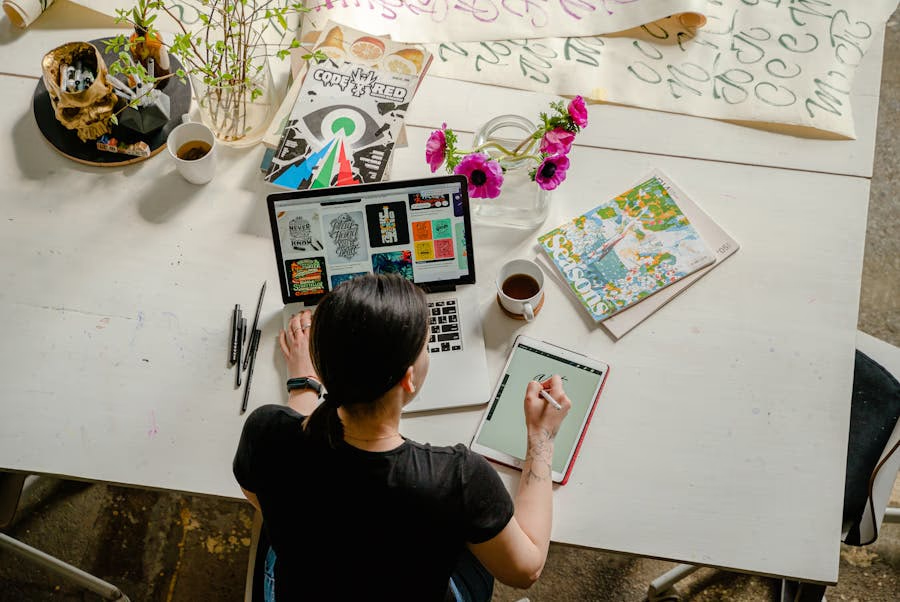
This is where the artisan process becomes most visible. After printing, every relief is inspected, cleaned, and finished by hand. Surface imperfections are addressed. Edges are refined. The piece is prepared for mounting.
The finishing stage requires judgment that cannot be automated. Each relief has its own characteristics — areas where the topography creates overhangs, tight valleys where support material needs careful removal, edges where the transition from relief to frame must be clean. An experienced hand knows how to address each of these without compromising the geographic detail.
No two reliefs are identical. The nature of 3D printing means that each piece carries subtle variations in surface texture and layer definition. These are not defects — they are signatures of a handmade process.
Step 4: Frame Assembly
The wooden frame is cut, sanded, and assembled in the workshop. We use sustainably sourced wood chosen for its grain, weight, and finish. The relief is mounted into the frame by hand, secured, and inspected again before packaging.
Three frame finishes are available — black, white, and natural wood — and each requires different preparation. The natural wood finish reveals the grain and character of the timber. The black and white finishes are applied in the workshop and inspected for evenness and coverage.
The finished product is a framed city relief that weighs enough to feel substantial on a wall and looks precise enough to reward close inspection.
The Materials Philosophy
Every material choice in the process reflects a specific set of priorities: accuracy, sustainability, and longevity.
PLA was chosen over ABS and other common 3D printing materials because it produces sharper topographic detail at the layer heights we use. It is also the most environmentally responsible option available — derived from renewable plant starch rather than petroleum, and biodegradable at end of life.
The wood for the frames is sourced from suppliers who practice responsible forestry. We do not use MDF, particle board, or plastic frame alternatives. Wood has warmth, weight, and grain that synthetic materials cannot replicate, and it ages well — developing character rather than deteriorating.
Even the packaging is considered. Each piece ships in protective materials designed to prevent damage in transit while minimizing waste. The goal is that every element of the product, from the first data file to the last piece of packaging, reflects intentional choices rather than default options.
Made in Romania: What That Means
“Made in Romania” carries a specific meaning for us. It means:
- Local materials and labor — wood sourced regionally, printing and assembly done in Bucharest
- Short supply chains — fewer intermediaries, less transportation, more control
- Fair working conditions — every person involved in the process is paid fairly and works in a safe environment
- Cultural context — we are part of Romania’s growing community of makers, designers, and small-batch producers
Romania’s position in Europe also means efficient shipping to customers across the EU and UK, with reasonable transit times to North America and beyond.
There is a broader story here about Romanian craft. The country has a centuries-old tradition of skilled making — from the intricate woodwork of Maramures churches to the textile traditions of Transylvania. That heritage is not folklore. It is a living culture of people who work with their hands, who value precision, and who take pride in producing objects that last. Urban Frames exists within that tradition, updated for contemporary materials and methods but rooted in the same ethos: make it well, make it by hand, make it to endure.

The Difference You Can Feel
Pick up a mass-produced city print and a handcrafted city relief. The difference is immediate.
The print is flat, light, and uniform. The relief has weight. It has texture. Run your finger across it and you feel the streets, the elevation changes, the geography of a real place rendered in a real material by a real person.
This is what makes a handcrafted gift from Urban Frames different from a wall decoration you order from a catalog. It is an object with provenance — made in a specific place, by specific people, using a specific process. When you give it to someone, that story transfers to them.
There is a reason people keep handmade objects longer than manufactured ones. It is not nostalgia. It is recognition. You can tell when something was made with care, and that recognition creates a different relationship with the object. You do not treat it as disposable. You treat it as something worth keeping.
Why Do We Choose to Stay Small?
We could scale up. We could outsource printing to a larger facility, automate the finishing process, and ship frames assembled elsewhere. The economics would improve. The product would not.
Staying small means staying in control. It means every frame passes through the hands of someone who understands the process and cares about the outcome. It means we can say “handmade in Romania” and mean every word.
It also means we can maintain a direct relationship with each piece. When an order ships from the workshop, the person who packed it knows which city it represents, which size it is, and what the relief looked like when it came off the printer. That continuity — from data to finished object to customer — is only possible at a scale where every piece is accounted for.
Growth, when it comes, will come by adding more cities to the collection rather than by industrializing the production of the ones we already offer. The process stays the same. The care stays the same. The workshop stays in Bucharest.
Browse the Urban Frames collection to see the cities we currently offer, and know that whichever one you choose, it was made with attention and care in our Bucharest workshop.
Take this feeling home
Frame the memory before it fades
Choose a handcrafted relief frame to keep this story on your wall.